Winter Inventory: an obituary of the old blog
A confession
Coming back to this blog after a long hiatus is always tough. After each of the long breaks I’ve had in my writing, I encounter some combination of: forgetting my server password, forgetting my server address, changings laptops, changing locations, firewall issues, etc. and it always occurs to me that each iteration has a different flavor of issues. However, once the noisome technical bits have been resolved, the acutal writing part is generally pretty smooth, typically because I have a new idea that I’ve been wanting to try out and write about and the words generally come easily.
This homecoming is different in that when I stopped writing two years ago, I did so with the intention of never writing again. It was a conscious choice. At the time, I was in the midst of what I later realized was clinical depression and the things that this blog was intended to be based around - statistics, programming, data - no longer gave me any joy. While I had no plans to fully abandon the field or my job as a statistician, it was clear to me at the time that this blog was an exercise in futility.
You see, when I began writing this blog, it was the beginning of graduate school and I had nebulous notions of documenting my experience studying statistics, making fun or useful notes to myself for the future, and using publically displayed blog writing as motivation to explore new topics and tools. Sometime in late 2023, I suddenly realized that these surface level motivations were lies.
The real reason I started this blog to prove I was “smart, productive member of society”
Growing up online and unattended in nascent digital world replete with hustleporn content, I was infected with a belief that our meaning as human beings was extracting as much material value out of every moment. Time should be spent as much as possible on a small category of important thingsnamely school in the service of getting a job, a job in the service of getting money.
Even when time cannot directly be spent on these things, it can still be indirectly angled and reflected towards them. For example, time can be filled up with independent study of the latest fad tools in the service of being better at school and work. Alternatively, time can be spent in lifting weights, which is nominally in the service of getting healthy but in actuality was in the service of looking good so that I may obtain more ancillary, subconscious benefits from my peers at school and work. And of course, time can be spent on blogging (content-creating more broadly) which is in the service of getting recognition which in turn is in the service of getting more money.
This blog was meant to be a testament of how “hard” I worked and how much I was “passionate” about my chosen STEM field. This blog was me masquerading as a quasi-academic, trying to differentiate myself from “common people”. “Wow”, I would pretend to hear from whatever random passing readership I received, “This is certainly someone who has value. This is certainly someone who matters.”
How did I get to this point?
I’ve been trying to figure that out myself for a few years now. From what I know for certain, my personal process of my disillusionment was very sudden. I’d like to believe it was a creeping feeling that built over time, like a carpet moss lurching itself across the decaying forest floor, slowly, imperceptibly, until all at once it could no longer be ignored. However, I’ve nearly wrung out every ounce of my memory, both in and outside of my therapy sessions, and the reality is not so poetic. I keep coming to the conclusion that one day for no particularly special reason, everything I had built my identity on was a whole and perfect delusion. Ironically I don’t remember the exact day, but it’s almost certain I was in the midst of some long, circular phone call or some edit on a report I knew only two or three people in the entirety of history would read.
I’m hardly an unbiased observer when it comes to my own internal experiences, but for the reader’s benefit I’d like to say that the reason I believe that there must have existed a single inflective moment is because I suddenly found that I had force myself to do what used to be simple, unspoken tasks. All the little edits, reviews, standups, parlays, presentations, bargains, and surveys now suddenly took significant mental effort, my mind now having to now deal with a constant interfering chattering that I was a completely vestigial existence.
Why did I think that?
Hadn’t I accomplished a lot over the last four years?
Papers were indeed published. But I couldn’t shake the thought that they would have been published without me. Someone else could have done the analysis, it wasn’t as if I had done something that truly no one else could have done.
And yes, projects were completed. But again, they too would have been finished without me. Someone else of course would have had to work in my stead, and while often tedious and demanding, the work was not particularly difficult. It is seems to me perfectly reasonable to think that any logical person would have accomplished what I was able to. Moreover, it was hard to shake the feeling that being at the tail end of the product life cycle, much of the creative development work were complete by the time my work began.
Yes, I was paid (and I spent some of that money as well). But I was never all that interested in material possessions or money to begin with, seeing it more as a necessary precondition to a fulfilling life, moreso than the fulfillment itself. I chose this life because I felt I was on a mission and that I was doing what I was supposed to be doing. When the walls came down and I was left holding some money with no actual accomplishment to speak of, my savings couldn’t rescue me from depression.
And of course, blog posts were written. But they were written because successful people that I idolized had blogs. And those blogs were about statistics, or data analysis, or programming, so of course my blog also had to be about those topics. God forbid I write about seomthing other than my chosen field, or worse, some topic or skill that cannot be easily monitized. Why waste your time writing poetry or songs when that time could be dedicated to machine learning.
In short, I subconsciously came to an eviscerating eureka moment that I was an entirely inconsequential person. There were futile conscious efforts to rationalize away this revelation, but the truth is funny in that the more you try to fight it, the more powerful it becomes.
What is this really about?
Now, I have to say that this is not an indictment of my employer, my management, or my profession. On the contrary, my company is a perfectly fine place to work, and the work itself is both honest and far from the worst thing one could be doing with their time (it wasn’t as if we are building killer drones or somerthing). I have always found my colleagues and managers wonderful, supportive people. This is really not about them. This is also not condemning the act of blogging.
Rather, this is a public confession that I placed all of my value in a certain idea of myself, that a foreign body that was implanted in me at a young age. For so long, I thought it was my work that gave me intrinsic value. This value was measurable, improvable, manipulable. When I finally saw that my work was as captivating and influential as the thin, dewy smoke wafting from a long doused campfire, forgotten and blown away by the constantly changing field, my perception of myself wafted similarly into the void.
The self-made illusion was that I was defined as a gainfully employed member of the techno-class, and therefore a productive member of society and doing exactly what I should be doing was destroyed. That I should be happy, that I should be obligated to be happy with where I was made the stranglehold even tighter. The guilt of having a comfortable, white-collar life and not being happy only compounded the anxiety I was facing, and led me spiraling deeper into depression.
How did that go?
I broke very quickly, exacerbating at every little imperfection in my work, in my studies, in my physical appearance, and letting it eat me alive. Several times a day, I would stand in front of the bathroom mirror, haggard, unkempt, swollen, literally shaking my head and let out a long, drawn out “fffffuck…” I became physically unable to sleep, whole nights were spent in frenzied tossing and turning, heart beating so loudly I couldn’t lay my head on it’s side or the sound of pumping blood would agitate me even more. Prescriptions for sleeping medication helped only temporarily, as the guilt of needing to use medication for something that should come instinctively to humans cancelled out any soporific effects. Several times I stood at the edge of the toilet, the sleeping pills in my hand, hesitating to throw them away. “I don’t need these. A normal person doesn’t need these! I’m a normal person, I’m a good person goddammit. What’s wrong with me? There’s nothing wrong with me!”
And the funny thing with insomnia is that while it’s impossible to sleep, eventually it becomes almost as impossible to get out of bed. Exhaustion permeates your whole body, and even shuffling from the bed to the couch was insanely taxing. At my loweest, my routine started by lying in bed for hours, stating at either my phone or the ceiling, then physically (as in my right hand grips and drags my left leg, then right leg) pull myself out of bed and hobble to the living room with a large couch to flop down upon. The couch was close to the wall socket, and served as my office during this time. Eventually the couch would become my entire base of operations, I would move in and out of the days on that couch, sleeping on it on the nights where the meds were efficacious. Attending calls and completing work were ironically a respite from what had become a living nightmare, some brief moments of distraction before I returned to the disquieting oblivion of depression.
Eating became extraordinarily difficult. The anxiety was so acute that it fried out the nerve signals for hunger and thirst. I would often forget to eat, often only having one small meal a day, generally some microwave soup or oven baked pizza (to this day, I have an extreme distate for Costco pizza, given how much of it I ate during this time period). In the span of about two months, I lost over to thirty pounds. Hair was starting to fall right out of my head.
Things got so bad that for the first time in my life, I saw a therapist. Paid for it out of pocket too. Maybe of all the things I’ve described thus far, this might be the fact that best communicates to a modern, male audience how desperate I felt.
I’ll take a moment here to step back and admit that of course it is unreasonable to pin all of this misery merely on my choice to be a statistician and blog about it. A lot of this can be attributed to underlying mental health issues that were exacerbated during the pandemic. I have no doubt there are many professionals who could dissect this and their end diagnosis would not mention any of the things I have written above. But I can only communicate my lived experience in this post, and on those grounds there is only one conclusion: my self-worth and my profession were inexorably tied (confounded if you will) and I cannot say I honestly believe that my depression would have happened if I felt purposeful and fulfilled with how I spent the majority of my day.
I went to therapy for close to two years, tried medications of different stripes, went to church, tried mediatation, read self-help books, and opened up to my loved ones. Thanks to some cocktail of the aforementioned, I am now much healthier and grateful for it. I continue to work as a statistician at the same company (they were generous enough to work with me while I was in the midst of my breakdown), but with a different perspective on the role work plays in my life. Getting into that new perspective here would be a bit much, shelving that for a future blog post perhaps.
Catching up with myself
Today, I read my own blog for the first time in years. Granted, two and a half years is not some extraordinary length of time, but you never know how much thins change until you do look back. I anticipated having a similar feeling to looking back through an old yearbook, grimacing at pictures that were cool exclusively in the moment and farewell messages composed entirely of edgy in-jokes. To my surprise, I genuinely enjoyed reading my old posts (wow how humble). I didn’t see anything terrible about the writing itself and I recalled flashes of genuine joy I had when working and drafting the posts. As I’ve already detailed, I believe these posts were written with the wrong motivations but I also believe that the opposite of love is apathy. And instead of being apathetic about my prior canon, I found myself engrossed in dumb little miscues.
For example, how low did I think of my readers, to assume some of them would be interested in a whole post about the hypergeometric distribution? Other items were straight up wrong. Why for instance didn’t I mention in my post on power calculations that the curves are bumpy because it’s simulation based? Or why even post about wedding partner simulations when I had not figured out any actual conclusions beyond “here’s a thing that I did.” The more I read, the more I found to complain about, but the more I found to complain about, the more I realized something about this blog. The motivation for this blog may have been misplaced, to demonstrate some asinine value about myself, but that didn’t mean there wasn’t an occasional spark. Looking back on these old embers makes me smile, and taught me one last thing more valuable than any statistical trivia or factoid.
Perhaps this blog wasn’t such a foolish endeavor. At least it’s clear to me now that I love writing. It might not always be about statistics and programming, and in fact rarely is so, but to steal a hackneyed phrase, to me writing feels right. This was meant to be a goodbye post, titled “obituary to the blog”, and now has to be retitled “an obituary to the old blog”.
But what to write about now?
Nanni and Ea-nāṣir
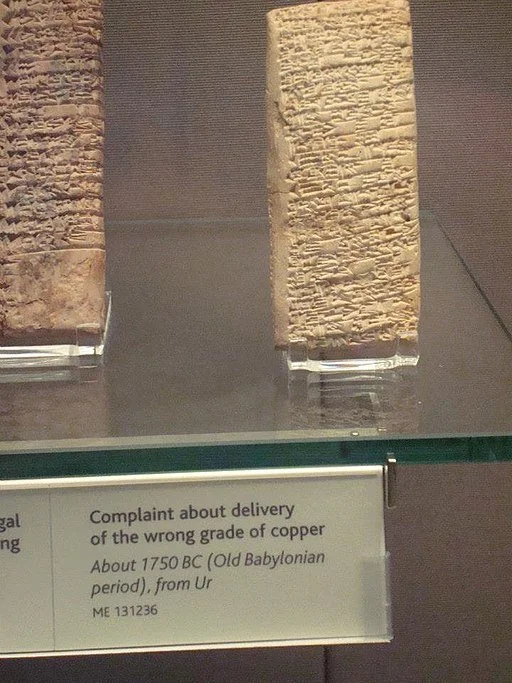
I first heard about Ea-nāṣir in the fine halls of Reddit University. In a small clay tablet from ~1750BC, a customer named Nanni accuses Sumerian copper merchant Ea-nāṣir of cheating him with poor quality copper and disrespecting one of his servants. The tablet itself is no Rosetta stone and is surprisingly small, measuring only inches across. It’s a curious footnote at best in the annals of archaeology.
But people are funny. Few can deny the grandeur in the Great Pyramids or the spectacle of the Colosseum, but nothing is as captivating as relatability. The complaint to Ea-nāṣir resonates with millions of modern day people from 4000 years in the Sumer’s future, because there’s no questioning it’s authenticity. Now, that’s not to say the contents of the tablet is true. We don’t have a rebuttal from Ea-nāṣir, and we don’t know anything about Nanni, who for all we know was the local insurance fraudster. But the clay tablet is fascinating not because we know all the facts of what happened. It’s fascinating because it’s a record of a real interaction between real people.
Among the great regents of history, who are perfectly aware they are building their legacy for millenia to come, and whose scribes and historians have every motivation to embellish, who knows what really happened? Sometimes, we don’t even know who actually existed. For example, important figures like Homer or Laozi are now believed to be purely apocryphal, and were merely pen-names that shared among several authors. It takes years of focused study to separate ancient history from myth, and even then, our picture is rarely complete. But in this one case, we have little doubt that Nanni and Ea-nāṣir were real people. A handwritten customer complaint is too trivial, too mundane, too universal to have been forged. Nanni and Ea-nāṣir may have hated each other in real life, but they were really here on this planet and they left a mark on the world. They played notes in the same symphony we’re carrying on today.
In the same way, I want to leave some genuine record of me. I don’t think it’s overly naive to think that this blog will outlast my human life; the internet is now replete with digital memorials, mementos, and facsimilies of people who are no longer alive. It would be such a regret if the blog I leave behind is full of contrived articles about statistics or Linux, things that ChatGPT driven content-farms can pump out with great efficiency. I hope to repurpose this blog as my Sumerian clay tablet, to write genuinely about whatever I feel is worth writing about. Sometimes it will be about statistics. Sometimes programming. But most times, I think it’ll just what it’s like living in a new city, or my honest thoguhts about random books, or the agony of getting back into exercising, or complaints on the local influencer culture, or the sadness of playing guitar by yourself, or the happiness of a simple task well done. Always, it’ll just be whatever I feel like writing about, no matter how mundane.
Someday, when I’m long gone…
“Wow”, the internet archaeologists hopefully will say, “This has to be a real person, he is of no signficance at all.”